Exploring the East Side Gallery: Street Art meets Cold War History in Berlin
There are few places where political history and contemporary culture collide quite as vividly as they do along the banks of the River Spree. Stretching for over a kilometre along Mühlenstraße in Friedrichshain, the East Side Gallery is the largest open-air street art gallery in the world. It occupies a preserved stretch of the original Berlin Wall, turning a concrete barrier that once divided a city and a continent into an enduring canvas for free expression.
For me, the East Side Gallery has always held a powerful fascination. With a lifelong passion for street art and Cold War history, visiting this site feels like experiencing the ultimate collision of both worlds. What makes it so compelling is that it does not stand still. While some of the most iconic pieces remain carefully preserved, the gallery constantly refreshes, evolves, and overpaints itself.
During my visits, I noticed blank spaces left open for new artworks, keeping the atmosphere vibrant, energetic, and entirely unique.
Best of all, it is free, iconic, and well worth seeing up close.
Must-See Artworks Along the Wall
With over a hundred paintings commissioned from artists across the globe following the fall of the wall in 1989, there is a tremendous amount of history to take in along the pavement. A few foundational pieces stand out as essential highlights for any visitor:
The Brezhnev Kiss (My God, Help Me to Survive This Deadly Love) by Dmitri Vrubel: Perhaps the most famous mural on the entire wall, capturing the notorious 1979 embrace between Soviet leader Leonid Brezhnev and East German President Erich Honecker.
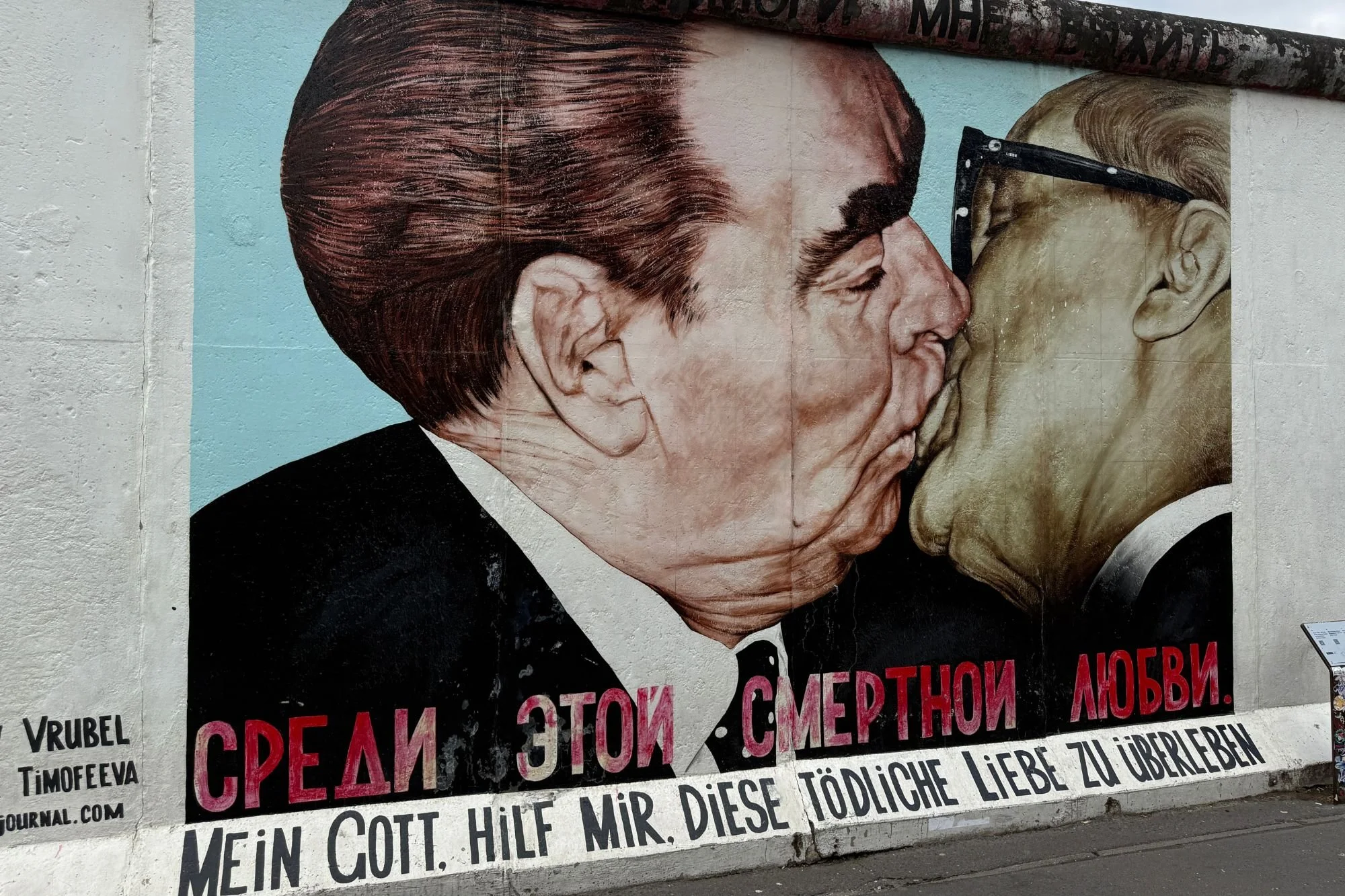
Mein Gott, hilfmir, diesetödliche Liebe zu überleben
Test the Rest by Birgit Kinder: This striking mural depicts a grey Trabant car smashing directly through the concrete wall. It captures the sudden, overwhelming rush of East Germans crossing into the West in November 1989.
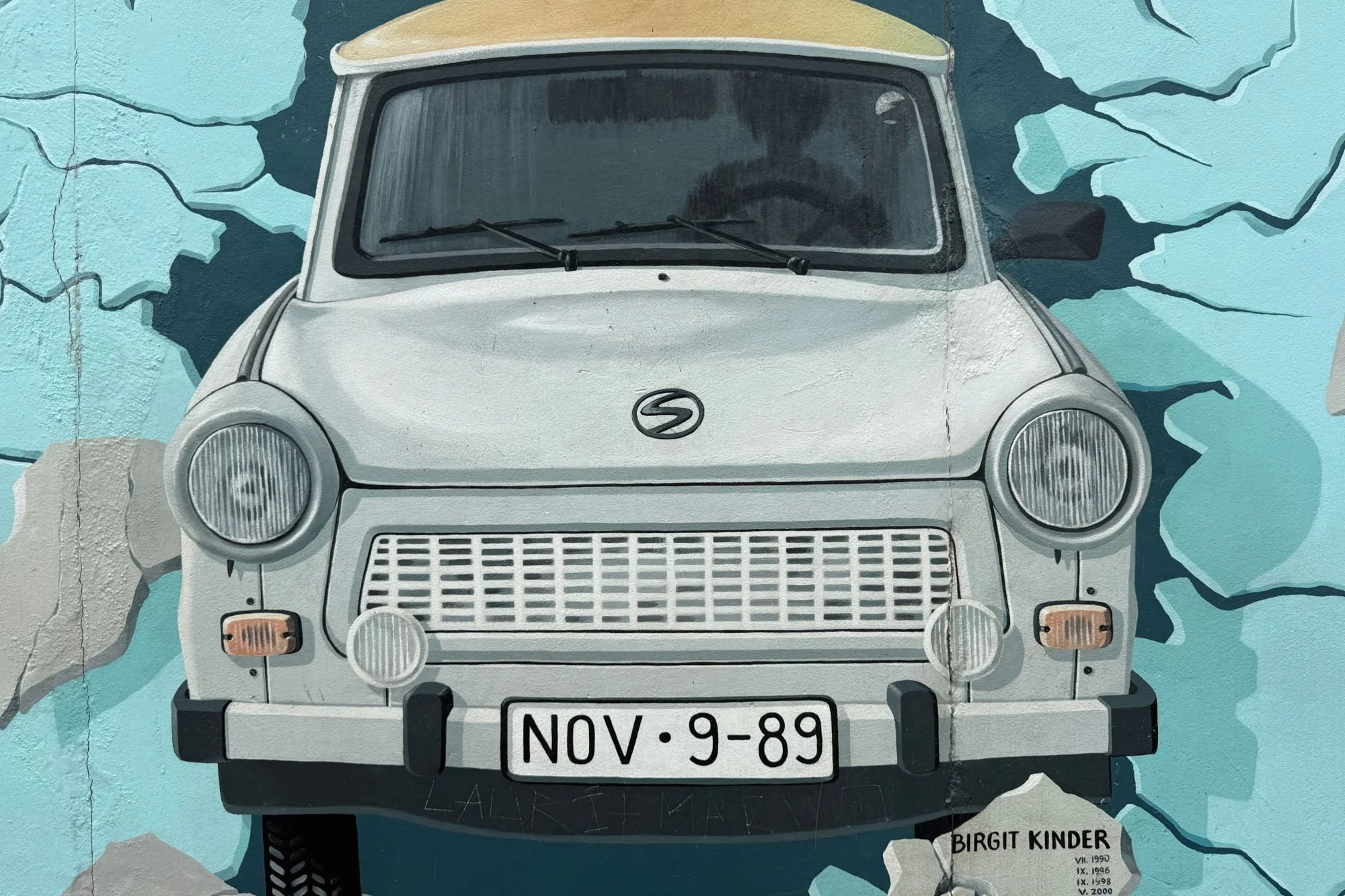
Test the Rest
It Happened in November by Kani Alavi. The artist painted the worried faces he observed at Checkpoint Charlie when the Wall opened in 1989. The image is intended to represent the fear of change and the future at that time.
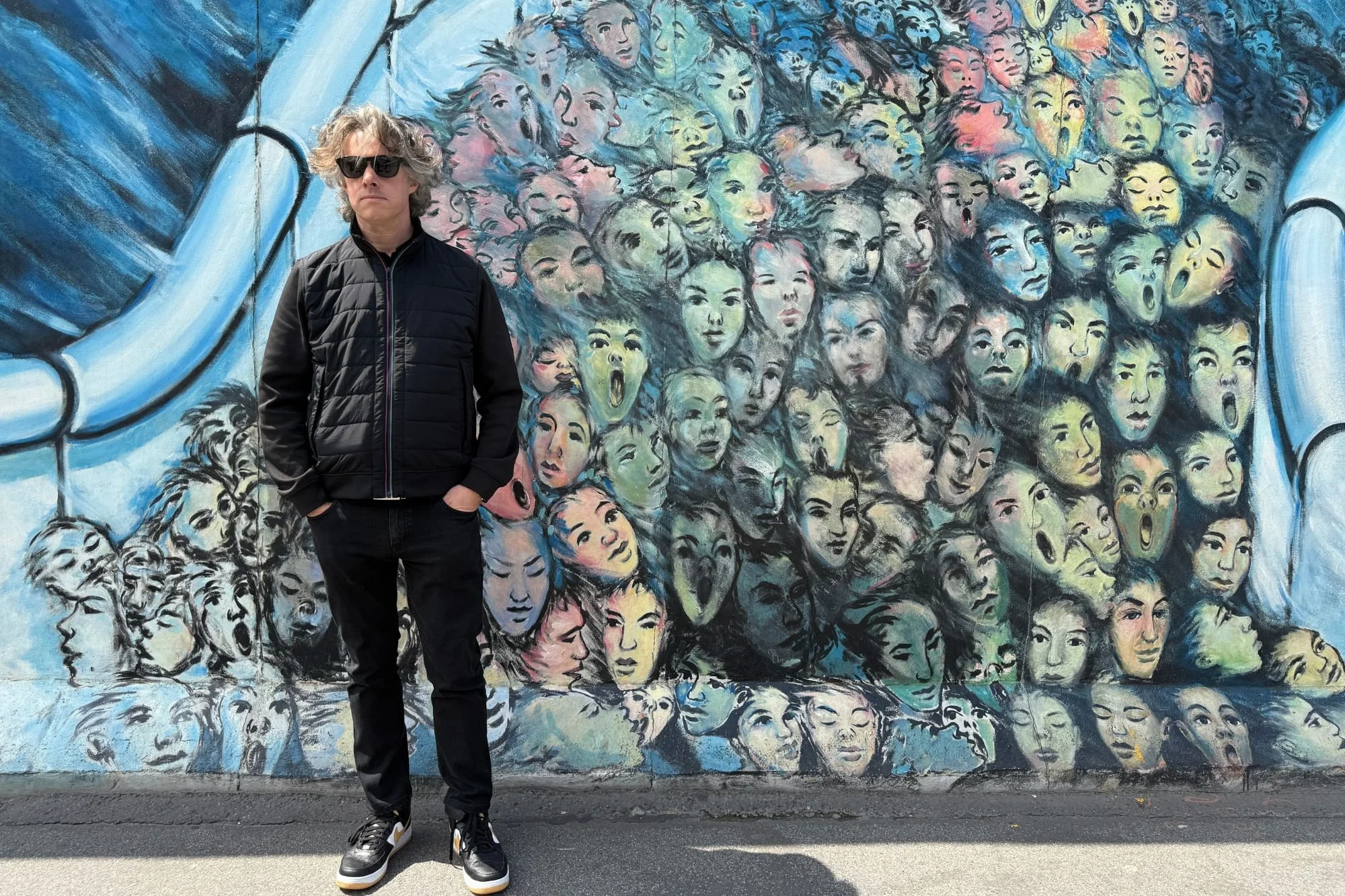
“Esgeschah im November”
Thierry Noir’s Colourful Heads: The French born artist was one of the earliest artists to paint the Berlin Wall while it was still standing, Noir's signature cartoonish, brightly coloured profiles are one of the longest artworks bring an unmistakable splash of colour to the grey concrete.
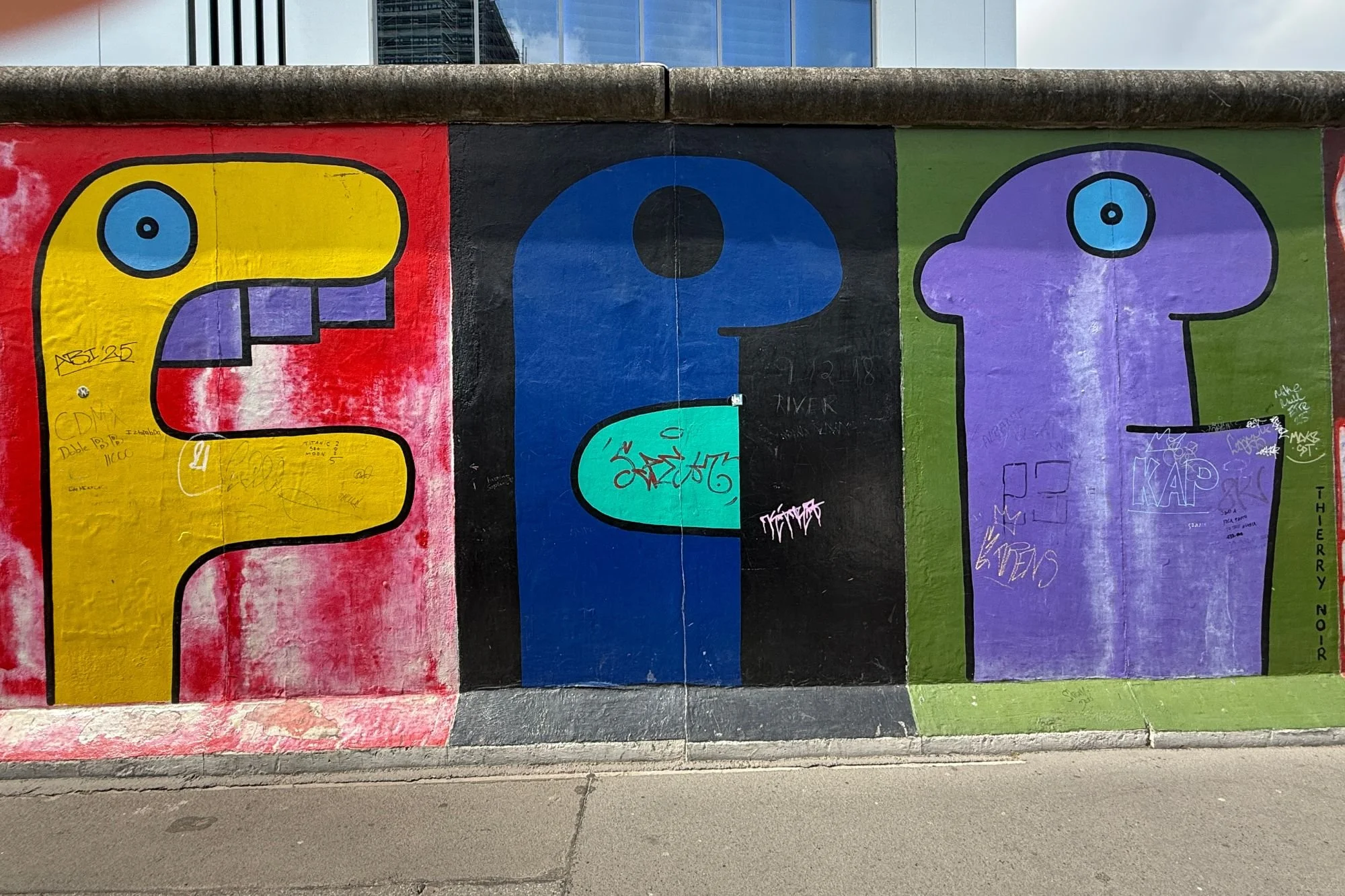
Hommage an die junge Generation
My Favourite Artworks
Beyond the standard history-textbook highlights, certain murals always draw me back. For some it’s the powerful images, or the bright colours. For others there is a defintie conneciton to music.
Test the Rest by Birgit Kinder: I have been fascinated by Trabbis ever since U2 & Thierry Noir made them cool with Achting Baby. It was also the first photo I took of the East Side Gallery almost 30 years ago. The same connection goes for Thierry Noir who would decorate a Trabbi for U2. I do love his colourful heads, too.
BERLYN by GerhardLahr : This large black mural just looks cool. The German Children’s book illustrstor lived with the wall. His painting “BERLYN” portrays the Berlin Wall in the first phase of reinforcement with a Y-shaped barbed-wire element.
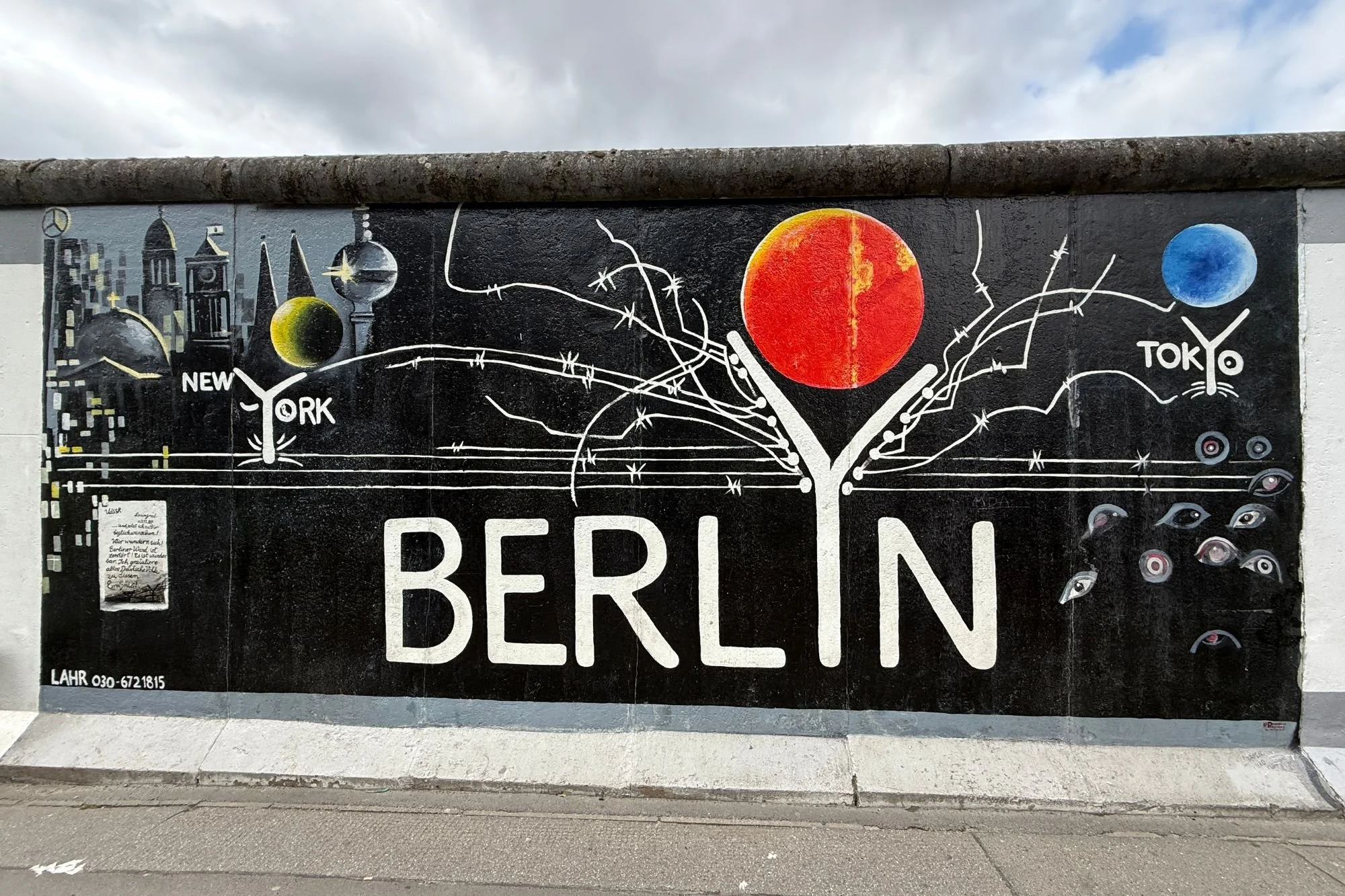
BERLYN
Dawn of Peace by Salvadore de Fazio: Featuring a bright yellow sun, a sweeping blue sky, and a stark white bird of peace, De Faziios’ contribution offers a striking moment of optimistic surrealism amidst the heavy historical context.
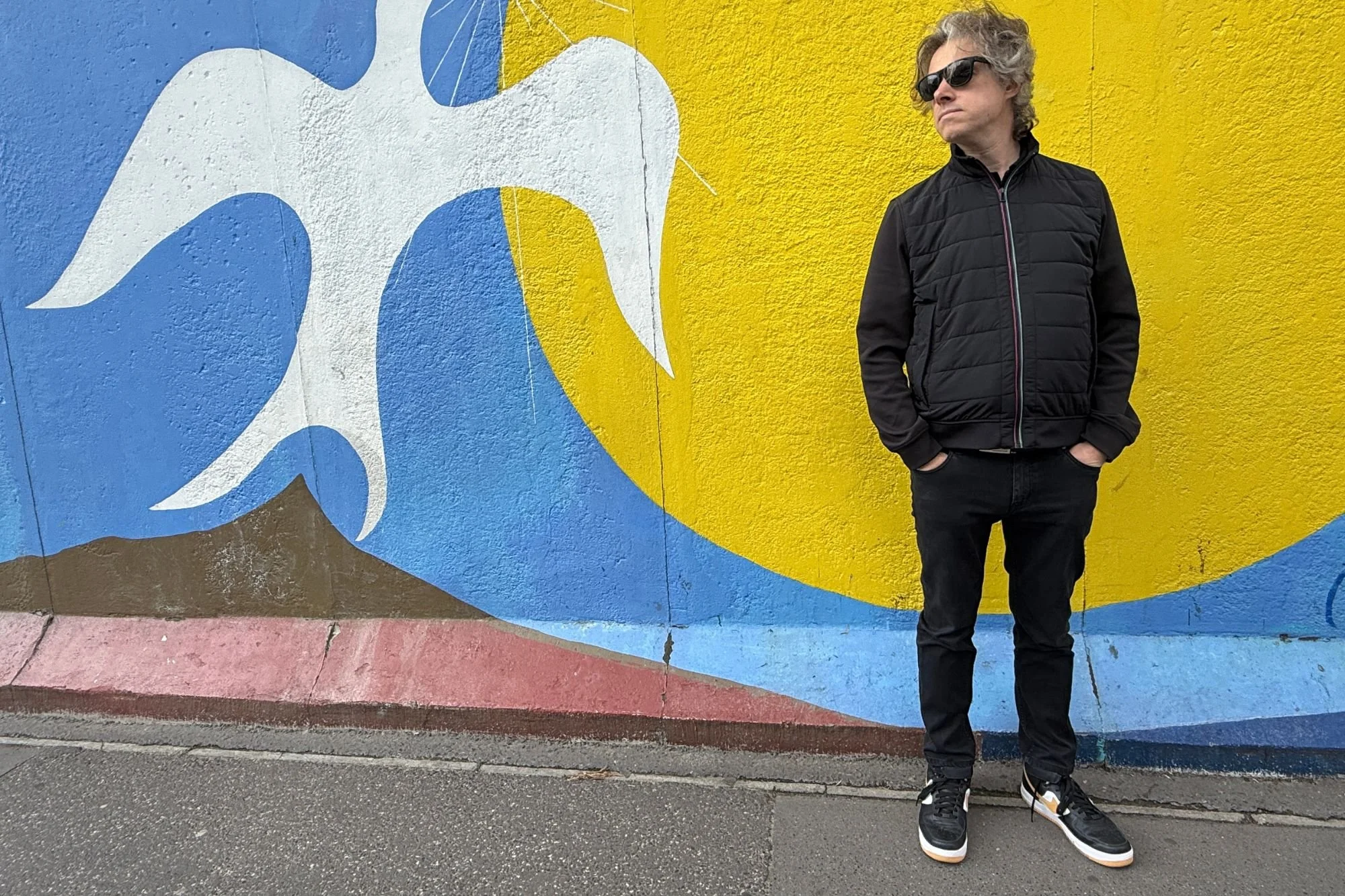
Dawn of Peace
Untitled by Georg Lutz Rauschebart: Soviet President Mikhail Gorbachev is depicted driving a Trabi with the steering wheel depicted as the Communist icon of the hammer and sickle.
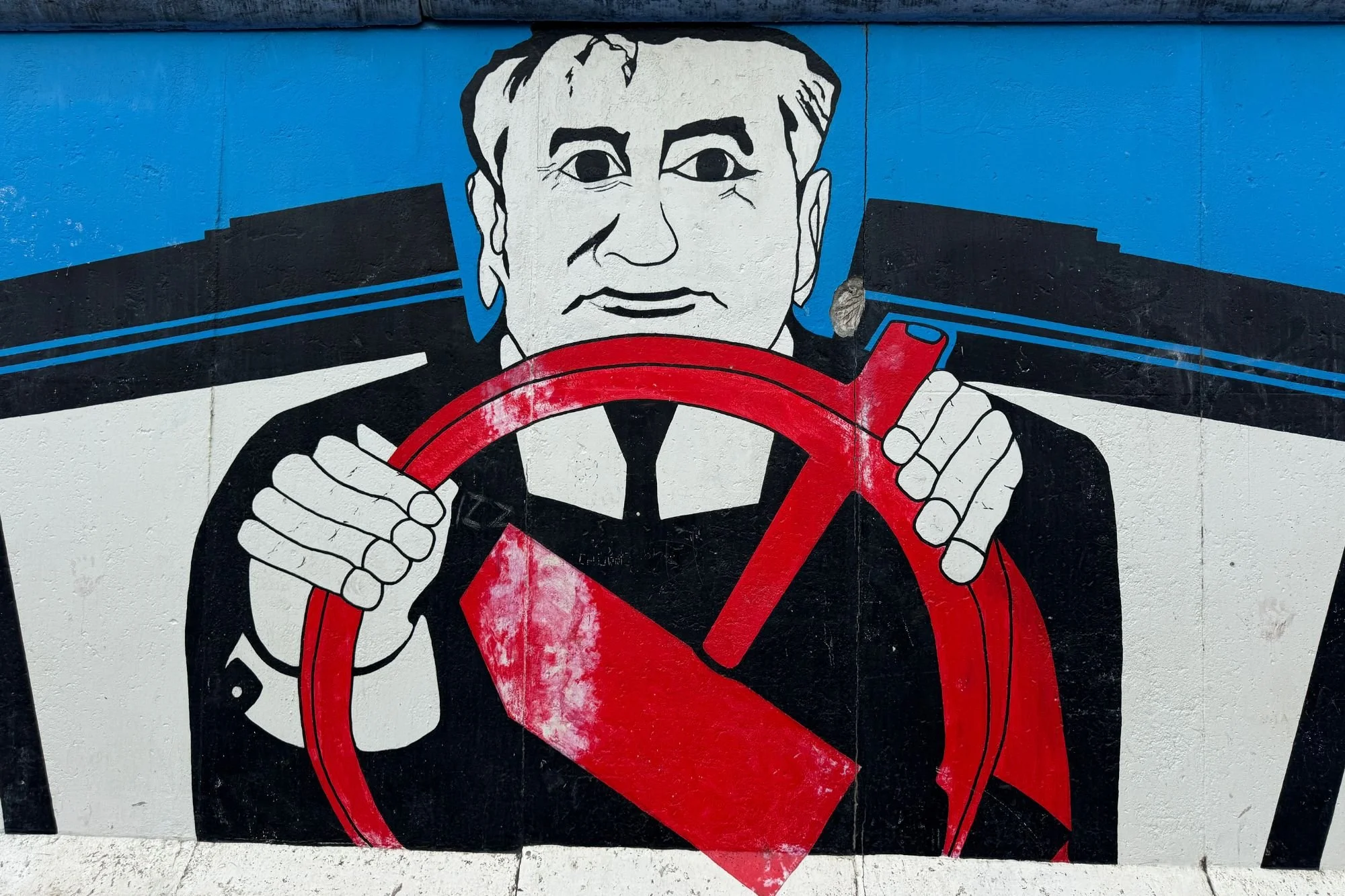
Untitled
The Wall by Lance Keller: Little is known of this artist except that he painted two murals on the East Side Gallery. This one is a copy and expansion of Pink Floyd’s The Wall artwork originally designed by Gerald Scarfe. As a massive Pink Floyd fan, who saw Roger Waters perform the Wall in the city’s Olympiastadion this was always going to get my vote!
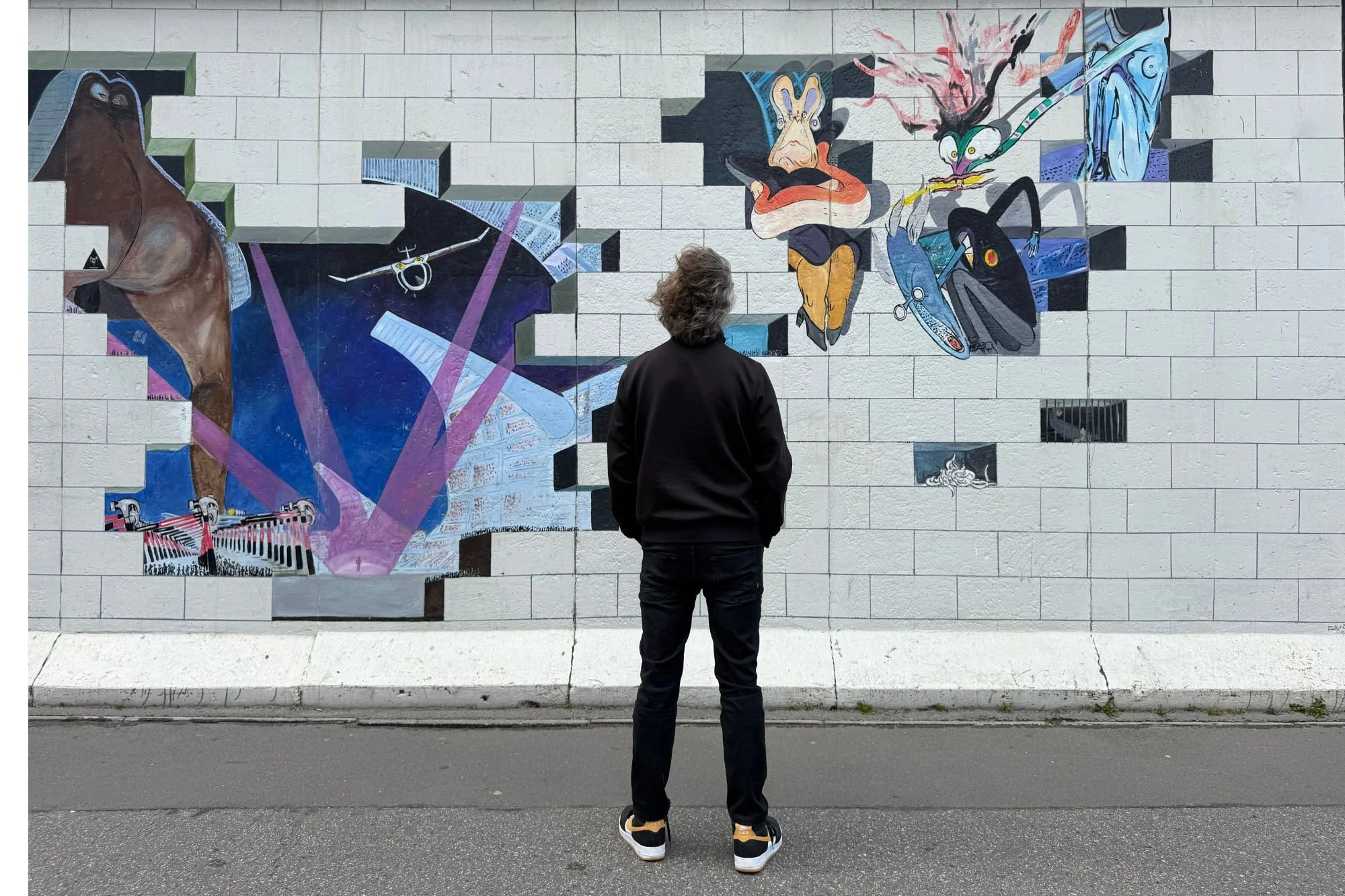
Pink Floyd, the Wall
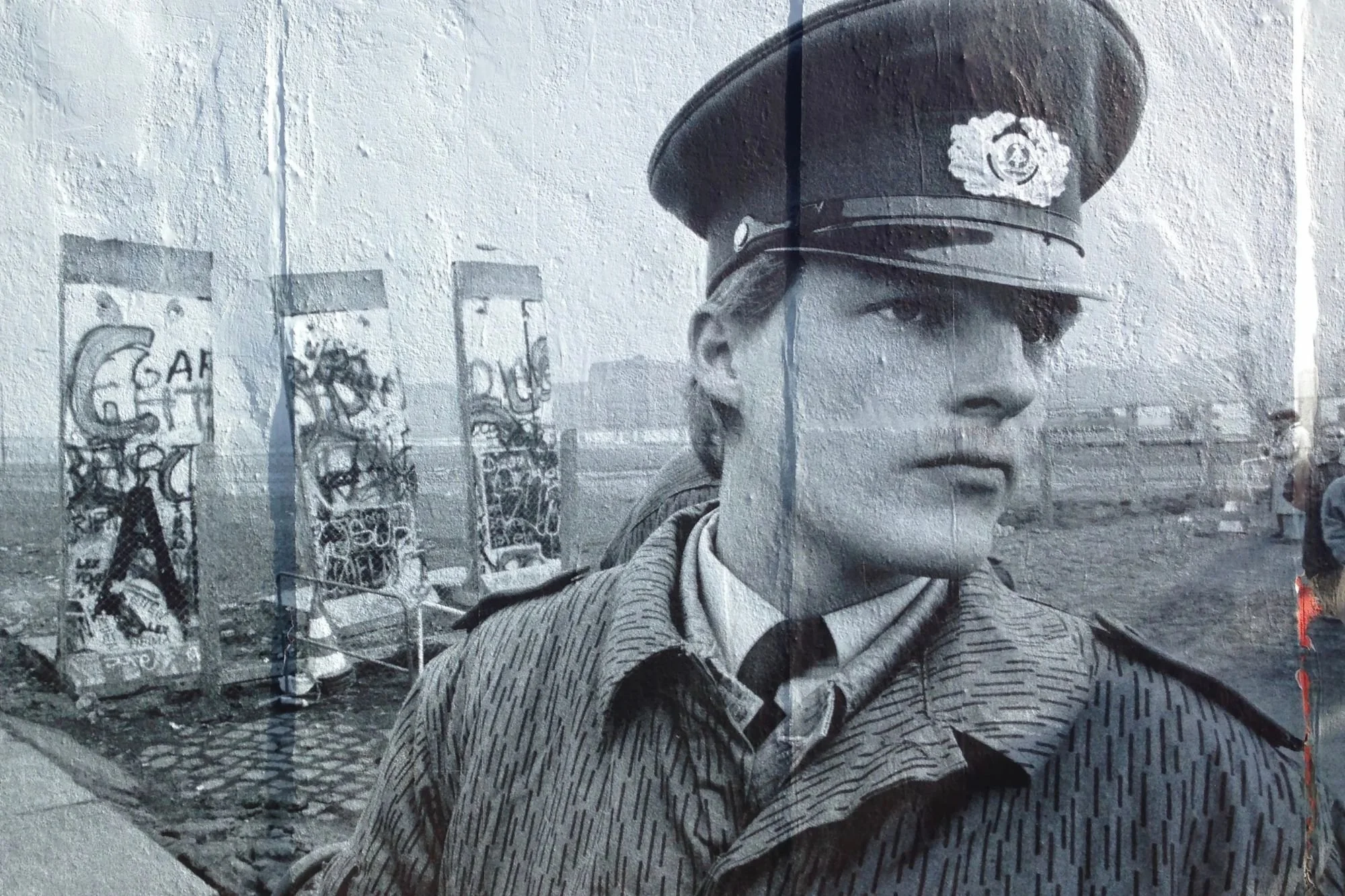
A photo of a German solider standing next to Graffiti’d sections of the Berlin Wall
Behind the Wall: Stepping Into the Death Strip
If you want to truly understand what this site represents, do not just stay on the pavement beside the painted facade. There are sections where the wall opens up, allowing you to walk onto the grass behind it, directly into what was once the original death strip of the Berlin Wall.
For me that open expanse of no man's land, looking across toward the River Spree, changes the entire experience. You will find a few lesser-known murals scattered back there, but the real power lies in simply standing where movement was once met with lethal force. For this was no-man’s land between the walls.
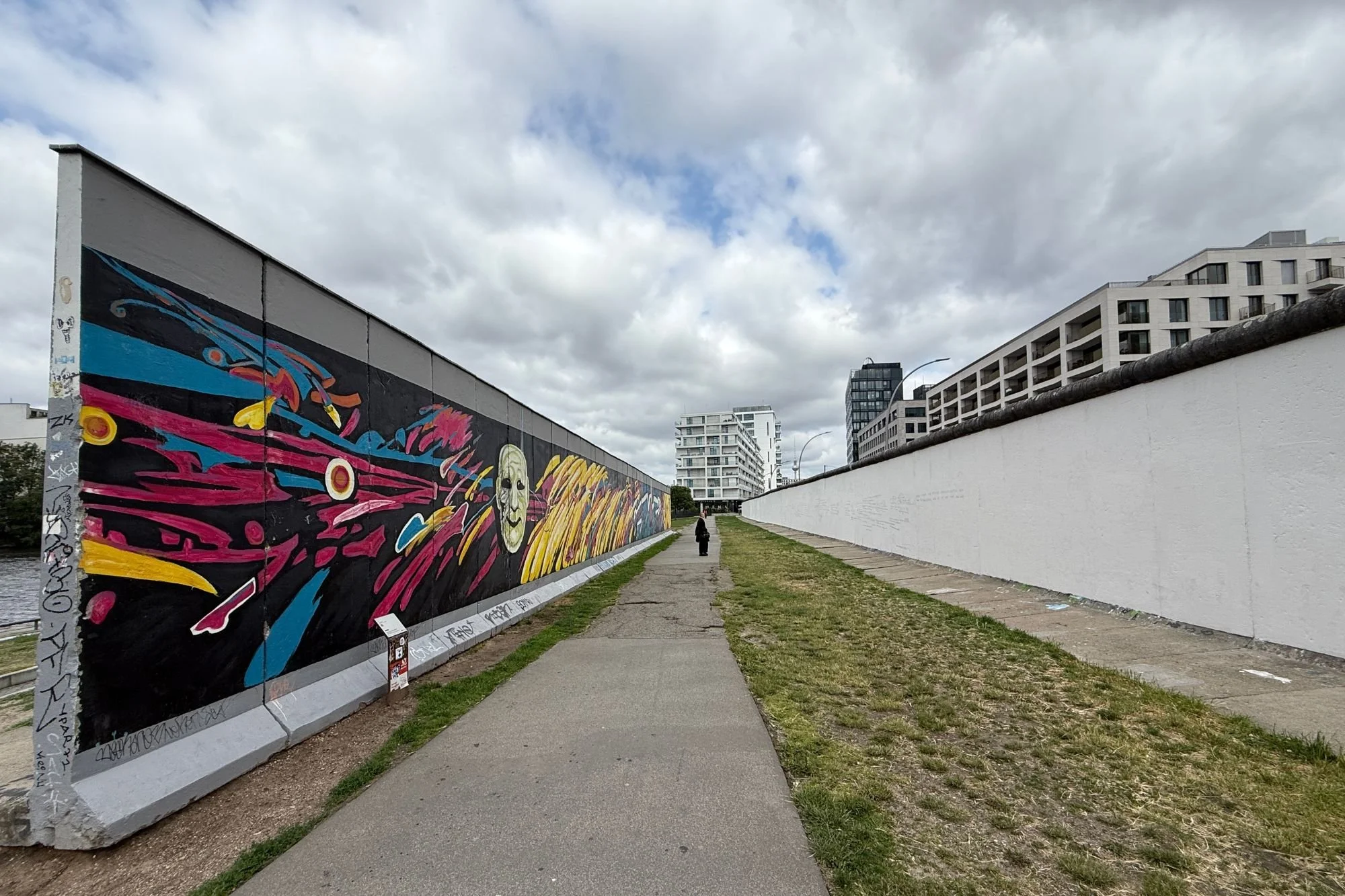
Between two walls in Berlin
A mix of history and hope, the East Side Gallery is something unique to Berlin. Grab your camera, take your time walking the pavement and the grass behind it, and let Berlin's most famous stretch of wall tell its story.
Practical Tips for Visiting the East Side Gallery
Cost: Completely free. As an open-air public installation, you can walk the length of the gallery at any time of day without tickets or queues.
Getting There: The gallery runs along Mühlenstraße between the Ostbahnhof and Oberbaumbrücke. It is easily reached via Berlin's U-Bahn and S-Bahn networks. You are near the Mercedes Benz Arena which also makes for another cool image.
Walking to Checkpoint Charlie and Hotel de Rome. It is an easy walk back to Checkpoint Charlie, the Trabant Museum and onto Hotel de Rome (where we stayed.) Allow for an hour, or longer if you want to stop for pictures.
When to Go: Visiting early in the morning offers a quieter, more contemplative experience before the crowds and tour groups arrive along the pavement.
For the best coffee shop near East Side Gallery head to Anima. It is a cool coffee stop along the wall, looking out over the Spree. Service was a little slow on our visit, but it’s a comfortable stop to recharge.
Visit the official website for more information on all of the artworks.